Book: The Hundred Dresses by Eleanor Estes; Illustrated by Louis Slobodkin
Challenge Prompt: Read a book with pictures
Pages: 80
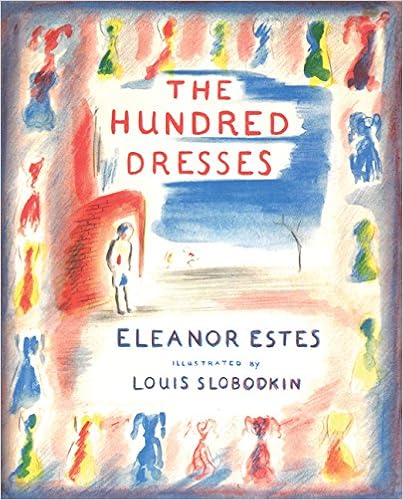 Eleanor Estes' Newbery Honor book, originally published in 1944, tells the story of three schoolgirls - Maddie, Peggy, and Wanda. Wanda Petronski, who lives in the "low-class" area of Boggins Heights, tells her classmates that she has one hundred beautiful dresses in her closet. Given that she wears the same faded blue dress to school every day, her classmates roundly mock and tease her for her "lie", in addition to her unusual last name. When Wanda and her family move away, Maddie is forced to consider her treatment of Wanda and if she should have behaved differently towards her.
While this book is first and foremost a book about teaching children to be kind to each other, it also holds life lessons for adults. Nearly half the book is devoted to Maddie's thoughts and actions after Wanda leaves; Maddie is wracked by guilt and a desire to atone for her actions, but atonement eludes her. Finally, she concludes that "she was never going to stand by and say nothing again... she would never make anybody else so unhappy again."
Much of the time, we think that we leave behind petty insults and childish taunts in... well, childhood. But as adults, I think we are simply more skilled at hitting the mark. We may not mock someone else about their clothes or their last name, but we find the things that make them... them and pick on them for it. But whether it's making fun of last names or driving a family to move because of repeated use of ethnic slurs, words hurt.
The old saying goes, "sticks and stones can break my bones, but words can never hurt me." But often times, words hurt more than physical injury - or at least they last longer. I still remember mean things that were said to me as far back as elementary school, and while I know that the things said about me were not true, it doesn't mean they didn't hurt.
But I'm starting to get off topic here. As you may be able to tell, this book has a message that hit close to home for me. This book is easily accessible for children, but adults who choose to read it will also find a more complex story lurking under the surface. At 80 pages, it's a short yet satisfying read.
One final note: Caldecott Medal winner Louis Slobodkin's illustrations are phenomenal and add a lot to the story. It's worth getting the book just to look at the illustrations.
Final Recommendation: Absolutely, you should read it! It's worth the small investment of time required to read it, and you'll probably find yourself coming back to it time and again. I know I will!
Book: All the Light We Cannot See by Anthony Doerr
Challenge Prompt: Read a book from the library
Pages: 529
 Here it is: the first book review for the 26 Books Challenge! Having heard great things about this book, I decided to pick it up from the library and give it a try.
All the Light We Cannot See tells two concurrent (and eventually, intertwining) stories - the first about Marie-Laure LeBlanc, a blind French girl who flees with her father from Paris to the seaside village of Saint-Malo; the second about Werner Pfennig, a German orphan who is a prodigy with radios and technology. As World War II winds down, Marie-Laure and Werner's stories get closer and closer until they finally intersect.
Add to that a German sergeant major searching for a legendary gemstone, a scale model of Saint-Malo, and the French Resistance, and you have All the Light We Cannot See, a compelling and thought-provoking tale.
Doerr's writing style is unique, and I personally had trouble getting into it. I particularly had some trouble with the fact that the timeline jumps back and forth - not trouble tracking with the story's timeline, but it made the novel seem disjointed to me. I don't say this as a knock on Doerr, just an observation. On a positive note, I found many of the characters extremely compelling, particularly the highly intelligent and intuitive Marie-Laure. Werner's unchallenged acceptance of Nazi propaganda had the dual effects of making me think about the nature of good and evil versus what society says is good or evil and making him a rather unsympathetic character until the end (in my eyes, at least).
But maybe that was Doerr's point - that many people, either during World War II or today, blindly follow what society tells them until they "see the light", so to speak. Though Marie-Laure is blind, she sees and observes more than most other characters, particularly Werner. While Marie-Laure is physically blind, Werner is socially blind. That's an inelegant way of phrasing it, but I hope you know what I mean.
Final Recommendation: Read it if you were already interested in it. If long (500+ pages), intellectual novels aren't your thing, you might want to skip this one. I enjoyed it, but am not necessarily sure I would read it again.
If you know me at all, you know I love books. I love books as much as Jane Austen loves happy endings, as much as the Brontes love the Yorkshire moors, as much as Mark Twain loves making fun of politics and politicians. I have a reputation at work for finding new books every other week or more. Yes, I may need to seek professional help. :)
